


Fall arrives quietly, then the first hard freeze arrives all at once. A hose left connected, a gutter packed with leaves, or a furnace filter that should have been replaced in September can turn into a burst pipe, an ice dam, or a no-heat emergency in January. This fall home maintenance checklist breaks the work into 27 manageable tasks, ordered by urgency, so nothing critical slips through.
Most jobs need only basic tools, a free weekend, and supplies from stores such as Home Depot, Lowe’s, or Ace Hardware. A few are better booked with a professional, this guide flags those, with typical costs. Once this list is done, how to winterize your home covers the same house room by room.
Table of Contents
Quick Start: The 7 Tasks That Can’t Wait Another Week
If time is short, start here. These seven tasks prevent the most common, costly winter failures, and several become much harder once temperatures stay below freezing.
1. Disconnect and drain garden hoses. A hose left attached traps water in the outdoor faucet and the pipe inside the wall. When that water freezes and expands, the pipe can split. Disconnect, drain, and store every hose indoors.
2. Shut off and drain exterior faucets. If your home has an interior shutoff valve for outdoor faucets, close it, then open the outdoor faucet to drain remaining water. Leave the outdoor faucet open for winter.
3. Clean the gutters. Leaves and debris hold moisture against the roof edge. In freezing weather, that debris can contribute to ice dams, overflowing gutters, and water backing up under shingles.
4. Swap in a clean furnace filter. A clogged filter restricts airflow, forces the system to run longer, and can contribute to shutdowns. Start the season with a fresh filter and note the size printed on the old one.
5. Test-run the heating system. Set the thermostat to Heat, raise the temperature a few degrees, and run the system for 15 to 20 minutes. Confirm warm air from the registers. Loud banging, short cycling, or no heat should be checked now, not in January.
6. Test smoke and carbon monoxide detectors. Press the test button on every unit. Replace batteries if a chirp has started, and check the manufacture date. Most detectors should be replaced after 7 to 10 years, depending on the model.
7. Reverse ceiling fans. A small switch on the motor housing changes blade direction. In winter, running the fan clockwise on low pushes warm air collected near the ceiling back down without a cooling breeze.
Finishing just these seven tasks puts you ahead of the most urgent risks. The sections below complete the remaining 20 tasks.
Exterior: Roof, Gutters, and Siding Checks
The exterior takes the full force of winter weather, so small gaps and blockages matter more in October than in July.
Safety first: Ladder and roof work carries real fall risk. Use a sturdy ladder on firm, level ground, keep three points of contact, never lean beyond the rails, and skip wet, icy, or windy days. If a roof is steep, high, or damaged, hire a professional instead. No checklist item is worth a fall.
8. Inspect the roof from the ground. Look for missing, curled, or cracked shingles, damaged flashing around chimneys and vents, and sagging areas. From the attic, look for daylight through the roof deck and water stains suggesting a leak.
9. Clear valleys and check flashing. Roof valleys collect leaves and needles. Clear visible debris safely from a ladder at the roof edge rather than walking on the roof, and confirm flashing around chimneys, skylights, and vents sits flat.
10. Clean the gutters and downspouts. Scoop debris into a bucket, flush with a hose, and confirm water flows through each downspout and away from the foundation. Extensions should carry water at least 3 to 4 feet from the house. According to the U.S. Environmental Protection Agency, directing water away from the foundation helps reduce basement and crawl-space moisture problems.
If climbing is not a good fit for your home, booking a gutter cleaning service before the first freeze is a high-value appointment. A typical visit typically costs $100–$250; varies by region, house height, and gutter length. Book early, schedules fill quickly in October and November.
11. Consider gutter guards if cleaning is a recurring problem. Homes under heavy tree cover may need cleaning twice a year or more. Gutter guards (mesh, screen, or surface-tension covers that keep out leaves while letting water in) can reduce cleaning frequency, though not eliminate maintenance. Basic options typically cost $0.50–$3 per linear foot for materials; varies by region and product type.
Gutter Guard Kit 48FT (12 pcs), stainless mesh, fits 5-inch & smaller
Mesh covers that keep leaves out while letting water in, cutting how often you climb up to clean.
Check price on Amazon
12. Walk the siding and foundation. Look for cracked paint, caulk gaps around windows and utility penetrations, and foundation cracks. Seal small gaps with exterior caulk. Check that soil and mulch slope away from the house and are not piled against siding.
13. Trim back tree branches. Branches over the roof can drop under snow and ice loads and scrape shingles in wind. Trim branches that overhang the roof or touch siding, or hire a tree service for anything large, high, or near power lines, never a DIY job near electrical lines.
Heating System: Filter Swap, Furnace Test-Run, Fireplace Prep
According to the U.S. Department of Energy, heating and cooling account for a large share of a typical home’s energy use, and regular maintenance helps systems run more efficiently and last longer.
14. Replace the furnace filter and stock a spare. Note the old filter’s exact size and airflow arrow, and install the new one facing the correct way. Disposable furnace filters typically cost $5–$20 each; varies by region, size, and filtration rating. Check monthly during heavy use and replace when the filter looks gray and loaded, or follow the manufacturer’s schedule.
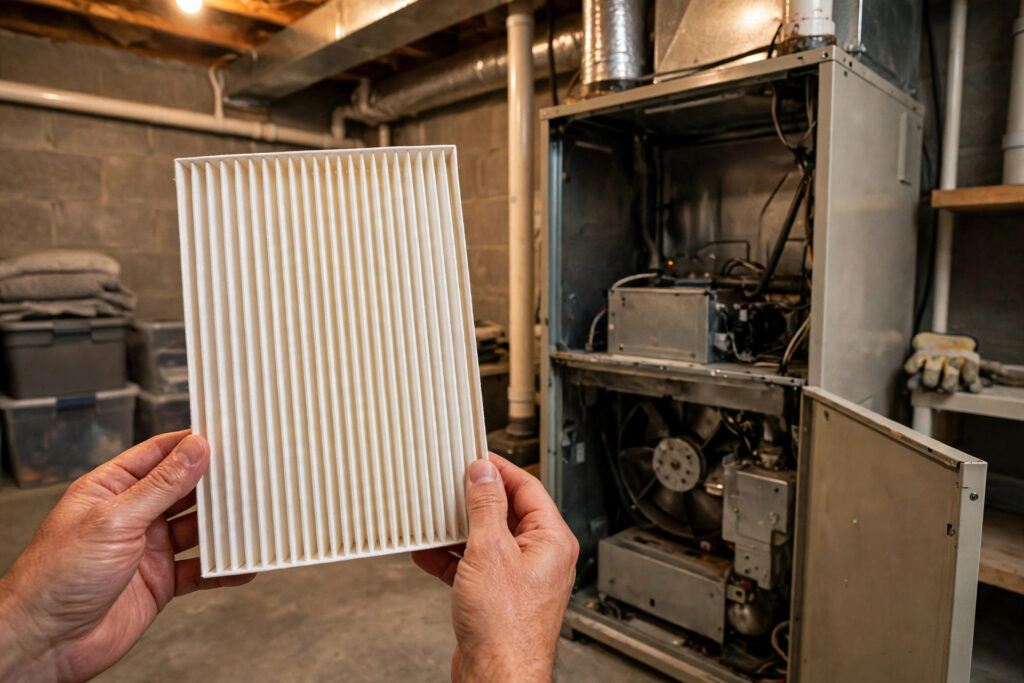
Filtrete 16x25x1, MERV 11, MPR 1000, 6-pack
MERV 11 filtration in the common 16x25x1 size, sold as a 6-pack so you have a spare.
Check price on Amazon
15. Complete the full test-run. Walk through the house while the system runs. Confirm each room gets airflow, listen for rattling or grinding, and check the thermostat responds when lowered. If the system struggles, these checks for a furnace not turning on help separate simple fixes from problems needing a technician.
16. Clear the area around the furnace and water heater. Keep at least 3 feet of clear space around heating equipment. Move paint, solvents, cardboard, and other flammable storage away. Vacuum dust from the unit’s exterior and from nearby registers and return grilles.
17. Check vents and registers. Furniture, rugs, and curtains often block registers over the summer. Open and unblock every register so heated air can circulate. Close registers only in genuinely unused rooms, and only partially, closing too many can increase duct pressure.
For most homes, an annual HVAC tune-up service covers the internal checks a homeowner should not do: burner and heat-exchanger inspection, electrical connections, and safety testing. A fall visit typically costs $75–$200; varies by region, system type, and what is included. Booking in early fall usually means shorter waits than after the first cold snap.
18. Prep the fireplace, by booking a professional sweep. Creosote buildup inside a chimney is a fire hazard. The National Fire Protection Association recommends chimneys, fireplaces, and vents be inspected at least once a year. Chimney and fireplace sweeping should be done by a certified professional sweep (for example, one certified by the Chimney Safety Institute of America) who can clean the flue and check for cracks, blockages, and damage. Do not attempt DIY chimney cleaning; this guide provides no instructions for it. Meanwhile, confirm the damper opens and closes.
19. Set the thermostat strategy. ENERGY STAR recommends using a programmable or smart thermostat’s schedule so temperature can be set back while you sleep or are away. The U.S. Department of Energy notes that a setback of 7°F to 10°F for 8 hours a day can save energy, provided it does not risk freezing pipes.
Plumbing: Faucets, Hoses, and Pipe Protection
Frozen and burst pipes are among the most expensive winter failures, because damage often comes from water released after a pipe thaws, not the freeze itself. The American Red Cross emphasizes that pipes in unheated areas and along exterior walls are most vulnerable.
20. Insulate exposed pipes. Check the basement, crawl space, garage, and attic for uninsulated pipes, especially along exterior walls. Foam sleeves snap on in minutes with no special tools. Focus on pipes near vents or drafts.
21. Install foam faucet covers on every outdoor faucet. After hoses are disconnected and faucets drained, a foam faucet cover fits over the faucet and seals against the siding, reducing cold air reaching the pipe. Foam faucet covers typically cost $2–$5 each; varies by region and store, and take under a minute each to install.
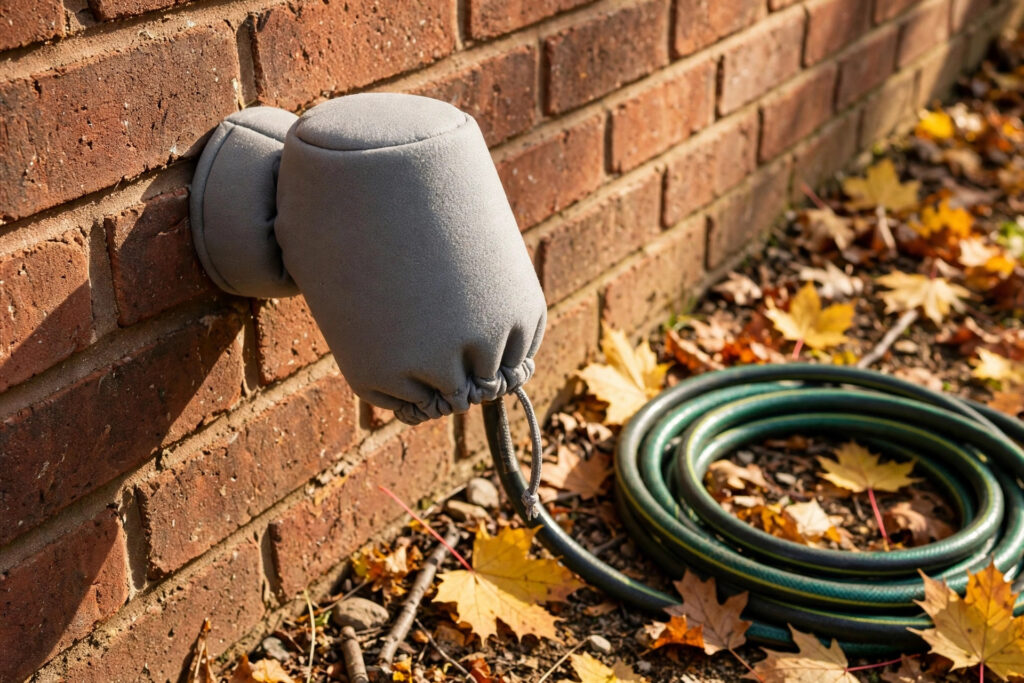
Outdoor Faucet Covers 2-pack, foam, 7″D×5″W×9″H
Foam covers that fit over outdoor faucets in under a minute each.
Check price on Amazon
22. Know the main water shutoff. Every adult in the house should know where the main shutoff valve is and how to turn it off. Label it if it is not obvious. If a pipe bursts, shutting off water quickly limits damage most. Test the valve. Older gate valves can seize from disuse.
23. Drain and shut down the sprinkler system. In-ground irrigation must be shut off and drained before freezing temperatures, following the manufacturer’s procedure. In many climates this is done with compressed air by a professional; an incorrect blow-out can damage the system, so follow the manual or hire it out.
24. Check under sinks and around the water heater. Look for drips, corrosion on supply lines, and water stains in cabinets and around the heater’s base. Small leaks are cheaper to fix now than during a cold snap. For a fuller plan, see how to prevent frozen pipes, including actions at different temperature thresholds.
Windows, Doors, and Draft Sealing
Drafts waste heated air you have already paid for. According to the U.S. Department of Energy, reducing drafts and air leaks can save energy, and sealing leaks is usually one of the lowest-cost improvements a homeowner can make.
25. Test for drafts and seal what you find. On a breezy day, move a lit incense stick or thin tissue strip around window and door frames, outlets on exterior walls, and the attic hatch. Movement signals moving air. Fixes include:
- Weatherstripping for doors and operable windows. Replace flattened or cracked strips. Foam tape, V-strip, and door sweeps typically cost $5–$25 per door or window; varies by region and material.
- Caulk for stationary gaps, such as exterior trim around window frames.
- Attic hatch sealing. Often the largest single ceiling gap. Add weatherstripping around the opening and an insulated cover made for the purpose.
- Window film kits for single-pane or noticeably cold windows. A shrink-film kit adds a still air layer for the season. Kits typically cost $5–$15 per pack; varies by region and size.
26. Check door thresholds and sweeps. Daylight under an exterior door means heated air escapes at the same gap. Adjust the threshold if it has screws, or replace the door sweep. Confirm doors latch tightly and deadbolts draw the door snug against weatherstripping.
Lock windows too. On many double-hung and casement windows, locking pulls the sash tighter against the frame, reducing drafts and rattling. Also check the garage door seal: the bottom rubber strip hardens and cracks over time, letting cold air into a space that often shares walls (and sometimes pipes) with the house.
Safety Round: Smoke/CO Detectors, Dryer Vent, Emergency Kit
The U.S. Fire Administration reports that heating equipment is a leading cause of home fires in winter, and carbon monoxide risk rises when furnaces, fireplaces, and fuel-burning appliances run for long hours in closed-up homes.
For protection, carbon monoxide detectors (including combination smoke and carbon monoxide detectors with a digital display) are widely available, and battery-powered or plug-in models with battery backup install following the manufacturer’s instructions. Units typically cost $25–$60 each; varies by region and features. The U.S. Consumer Product Safety Commission recommends CO alarms outside each sleeping area and on every level.
Kidde CO Detector, plug-in with 9V backup, digital display (KN-COPP-3)
Plug-in CO detector with 9V battery backup and digital display.
Check price on Amazon
Complete these checks to finish the round:
- Test and date-check every alarm. Test smoke alarms and CO detectors on every level and outside each sleeping area. Replace any unit past its printed limit, and replace batteries in units without sealed long-life batteries.
- Clean the dryer vent. Lint buildup reduces drying performance and is a recognized fire risk. Clean the duct run at least once a year, or hire a vent-cleaning service if the run is long or roof-routed. Clean the lint trap every load.
- Check fire extinguishers. Confirm one is accessible near the kitchen and its gauge is in the green. Many household units should be replaced or serviced after 10 to 12 years, per the manufacturer’s label.
- Refresh the emergency kit. Flashlights with fresh batteries, a battery or hand-crank radio, bottled water, a first-aid kit, blankets, and a phone power bank. Add ice melt for steps, and check snow shovels.
For longer outages, bottled water only covers the first day or two, the Water Freedom System shows a DIY way to generate drinking water from air at home. And pair the first-aid kit with know-how: Home Doctor is a practical guide to managing common household medical situations when help is not on the way.
Water Freedom System
A DIY way to generate drinking water from air at home.
Learn more about Water Freedom System
Home Doctor
A practical guide to managing common household medical situations when help is not on the way.
Learn more about Home Doctor
- Review space-heater rules. The U.S. Fire Administration advises keeping heaters at least 3 feet from anything that can burn, on a flat, hard surface, plugged directly into a wall outlet (never an extension cord) and off when you leave the room or sleep.
The Printable Checklist (Bookmark/Print Version)
Use this compact version to track all 27 tasks. Print or bookmark this page and check items off as you finish.
Quick Start (1–7): ☐ Disconnect and drain hoses ☐ Shut off and drain exterior faucets ☐ Clean gutters ☐ Replace furnace filter ☐ Test-run heating system ☐ Test smoke and CO detectors ☐ Reverse ceiling fans
Exterior (8–13): ☐ Inspect roof from ground ☐ Clear valleys and check flashing ☐ Flush gutters and downspouts ☐ Consider gutter guards ☐ Seal siding and foundation gaps ☐ Trim overhanging branches
Heating (14–19): ☐ Stock a spare filter ☐ Complete full test-run ☐ Clear space around furnace and water heater ☐ Unblock vents and registers ☐ Book professional chimney sweep, if applicable ☐ Set thermostat schedule
Plumbing (20–24): ☐ Insulate exposed pipes ☐ Install foam faucet covers ☐ Locate and test main shutoff ☐ Shut down sprinkler system ☐ Check under sinks and around water heater
Windows and Doors (25–26, plus garage seal): ☐ Draft-test and seal windows, doors, and attic hatch ☐ Fix thresholds, sweeps, and window locks; check garage door seal
Safety Round: The detector, dryer vent, extinguisher, emergency kit, and space-heater checks above complete the count, treat that section’s bullets as your final check-offs.
A realistic pace is one section per session: Quick Start and plumbing on Saturday, exterior and draft sealing on Sunday, the safety round in one evening. Book professional appointments the same week.
What to Book a Pro For, and What It Typically Costs
Some fall jobs need licensed or certified help, for safety or because they require equipment and inspections a homeowner cannot reasonably do. Ranges below are estimates for U.S. homes; varies by region, house size, and local labor rates.
- Chimney sweep and inspection: typically $150–$350; varies by region, flues, and inspection level. Book a certified professional sweep early, availability tightens once heating season starts.
- HVAC tune-up: typically $75–$200; varies by region and system type. Covers internal inspection, cleaning, and safety checks.
- Gutter cleaning: typically $100–$250; varies by region, stories, and gutter length. The clearest job to outsource if ladder work is a concern.
- Irrigation winterization: typically $50–$125; varies by region and zones, where a sprinkler system needs a professional blow-out.
- Tree trimming near roof or power lines: pricing varies too widely for a single range, get two or three written quotes and confirm the company is insured.
Call sooner if the test-run produces no heat, repeated shutdowns, or unusual smells beyond brief first-use dust; if you see active roof leaks; or if a CO detector alarms. A carbon monoxide alarm is never a wait-and-see event. Leave the home and call the fire department or gas utility from outside.
By contrast, filters, faucet covers, pipe sleeves, caulking, weatherstripping, and detector testing are homeowner tasks with basic tools. Splitting the list this way (DIY for low-risk work, professionals for chimney, gas, electrical, roof, and height work) is the most cost-effective way to finish all 27 tasks.
Frequently Asked Questions
When should you start a fall home maintenance checklist?
For most U.S. climates, late September through October, after summer heat fades but before the first hard freeze. In colder northern regions, starting in September is safer, because gutter, roof, and plumbing work is harder once temperatures stay below freezing.
How long do the 27 tasks take in total?
Most homeowners can finish the DIY tasks in one weekend, split across two or three sessions, plus professional appointments booked separately. The Quick Start seven alone usually take about two hours.
What is the single most important fall task?
Protecting plumbing and testing heating tie for first. Disconnecting hoses, draining exterior faucets, and covering them prevents a common burst-pipe scenario, while an early test-run leaves time to book a repair before HVAC companies get busy.
Do gutter guards mean you never clean gutters again?
No. Guards reduce debris and can cut cleaning frequency, especially under heavy tree cover, but fine debris and roof grit still accumulate, and guards need occasional clearing. Inspect gutters yearly even with guards.
How often should furnace filters and detectors be checked after fall?
Check the filter monthly during heavy heating use and replace it when loaded or per the manufacturer’s schedule. Test smoke and CO detectors monthly, and replace detectors when they pass the manufacture date printed on the unit, commonly 7 to 10 years, depending on the model.
Finish this list before the first freeze and winter becomes mostly a matter of watching the weather instead of reacting to it. Bookmark the printable checklist, book the professional appointments this week, and keep the spare filter where you will find it in December.